 Hi, you wanna know about us?
By: David Majury, Curtis Dewar, Philip Weller, Chris Bull & Richard Maw
Decades Apart
The idea of Decades Apart is pretty simple. I’ll choose 5 different albums from 5 different decades and I’ll share a little information about them and hopefully you’ll check them out if you haven’t already. Today is 1972, 1982, 1992, 2002and 2012. Whilst some these albums may not all be considered classics, they’re certainly amazing records. So be sure to check it out.
Deep Purple – “Machine Head” (1972)

Fate is a Deep Purple fan. It moves in mysterious ways, but its actions made a devastatingly big mark on the history of heavy music. What might have happened, you wonder, had a Frank Zappa concert on 4th December 1971 not ended in the burning down of the Montreux casino in which they were due to record? What would have happened if that fan-lit flare hadn’t been fired into the building’s roof? Would the record have sounded the same were they not forced to relocate, and indeed, what effect would it have had upon on the lyrics of ‘Smoke on the Water’, which were directly inspired by the whole drama?
That juddering four note riff echoes through the ages of time, it’s inspired thousands of young souls to learn the guitar and crowned what would become the band’s most successful record, topping the charts across the world. It became a definitive moment, not only in Deep Purple’s career, but in heavy music as a whole. It turned so many people onto heavy music. So many of these people would then go on to become greats in their own right, the likes of Iron Maiden and Metallica, to name but two, owing so much to the song. With that riff, Deep Purpleforged a legacy. Yet it could have all been so different had that fire not happened.
Through Ian Gillian’s inimitable introduction on ‘In Rock’, their sound had gotten hairy, lairy and beastly. But with 1972’s ‘Machine Head’, they learnt to tame their monster.
‘Highway Star’ the rocket fuelled, gas-guzzling opener sets the tone of the album. With its breathless rapidity and scintillating duelling solos courtesy of Ritchie Blackmore and the late, great Jon Lord, they sounded deadly. Quickly followed by the tumultuous stomping riff of ‘Maybe I’m A Leo’ and ‘Pictures of Home’, a song powered by Ian Paice’s thunderous drums and boasting some gorgeous, soaring melodies, this was their finest moment. ‘Lazy’ is drawn out, ethereal and savage all the same, ‘Space Truckin’’ packing gigantean, insurmountable grooves. Every song on the record is gold.
And the rest is history.
Twisted Sister – “Under The Blade” (1982)

1982 saw the release of what is perhaps one of the most underrated albums in the history of heavy metal: "Under the Blade" by Twisted Sister. While many modern day metal fans take a look at the band's heavy make up/transvestite image and automatically think "hair metal", the actual truth is that they were much closer to Judas Priest and even AC/DC in sound. While Twisted may have never reached the stellar heights of those two bands, the quality of "Under the Blade" (and later albums) cannot be denied. The album contains track after track of classic songs like "What You Don't Know (Sure Can Hurt You)", "Run for your Life", "Shoot 'Em Down" and "Sin After Sin" that definitely give other classic albums such as "Screaming for Vengeance" and "The Number of the Beast" a run for their money.
If you're one of those who never bothered to check the band out due to the 'glam' metal image, I highly recommend that you start with "Under the Blade" and then proceed to listen to the rest of the band's discography.
Darkthrone – “A Blaze in the Northern Sky” (1992)

After the release of the solid yet unspectacular 'Soulside Journey', Darkthroneembraced the flourishing black metal scene that was sweeping through the fjords and recorded 'A Blaze In The Northern Sky'. While many believe 'Under A Funeral Moon' and 'Transylvanian Hunger' to be the pinnacle of the band's corpse painted output, it was on 'A Blaze...” where they were at their coldest.
Starting with the ceremonial drums of the epic 'Kathaarian Life Code', a song which opened my eyes to the wonders of frost like atmosphere, Darkthrone laid down the blueprint that they would follow for years to come. While they had a few death metal riffs left over ('Paragon Belial' in particular), at the core is a dark and grim heart that bleeds the purest blackness. The guitars may sound like a swarm of wasps, but that was their intention on this, to make it as lofi and "necro" as possible.
Starting with the ceremonial drums of the epic 'Kathaarian Life Code', a song which opened my eyes to the wonders of frost like atmosphere, Darkthrone laid down the blueprint that they would follow for years to come. While they had a few death metal riffs left over ('Paragon Belial' in particular), at the core is a dark and grim heart that bleeds the purest blackness. The guitars may sound like a swarm of wasps, but that was their intention on this, to make it as lofi and "necro" as possible.
Floor – “Floor” (2002)

Inspirational records don't come along very often. The Stooges "Funhouse" was one when I first heard it around the late '80s, "Nowhere" by Ridearound 1990 was another and "Bullhead" by the Melvinschanged things again about a year later. I didn't play guitar when I first heard those records, but I did by the time I heard Floor's self titled album.
I remember reading that when musicians saw The Sex Pistols they quit their bands and found punk, and for me hearing Floor was a similar experience. I quit the crust-stoner band I was in, tuned down and started on my endless quest for the ultimate combination of riff and tone. It's impossible to talk about Floorin other terms, as the record is absolutely bursting at the seams with both. When that opening low throb of "Scimitar" kicks in there is no way to avoid the crushing power of that riff. Every cliché for reviewing how heavy music sounds (glacial, tectonic, seismic, engulfing, etc etc) began with this riff. I immediately knew that less is more, that regular musical theory is obsolete and that "chops" mean nothing.
If Floorhad just played that opening riff for the duration of the record it would still be one of the most magical records ever recorded, but of course they were/are way better than that. Every song is just loaded with riffs that other bands would kill for, only Floor would throw three of them into a two minute song. There was no indulgence at all, no filler, no need to repeat anything to fill space. This album is a template for how to use dynamics in heavy music, but what sets it apart from every other ‘tuned to z’ band is the melody.
Although I’ve grown up with Black Sabbath and all the rest, I’ve always loved melody in a song. The cookie-monster death grunt thing never appealed to me, and I’d been listening to bands like The Pixies a lot more than any heavy music for years. Suddenly here was a band with the heaviest riffs ever, but welded together with unbelievable melody and heart-wrenching vocals. One listen to “Tales of Lolita” was enough to completely change how I wanted to play music forever, and I suppose I’ve spent the last ten plus years with Slomatics trying vainly to even get close to what Floordid so effortlessly on this record. Add to all this, the fact that the band were almost completely unknown, that every live picture I could find of them was playing to a half-empty tiny pub, and that they’d never even been out of the States and I was hooked.
What a legacy to leave for the then-defunct band. I’ve a friend who has a theory that in every city there is a band somewhere, whether in a practice room or playing one of those half-empty tiny pubs, which would absolutely blow your mind. Floorwere that band for me, and although they are now deservedly much more well known, at the time the very fact that they had existed and had written that beautiful record was enough inspiration for me to do what I’ve been doing since, and will never stop doing.
Dragged Into Sunlight – “Widowmaker” (2012)
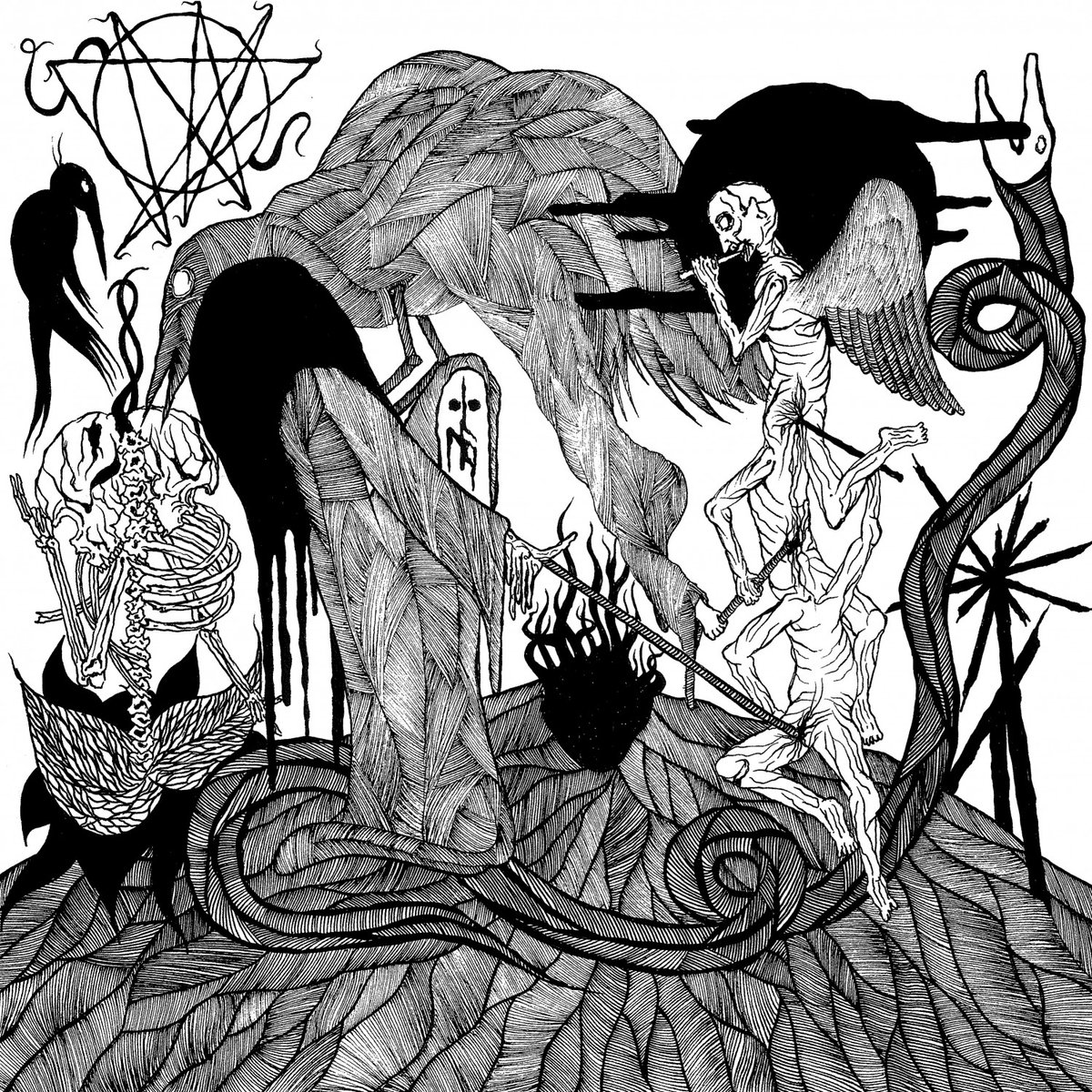
In a time when everything is known about everyone and there is no sense of mystery about anything, Dragged into Sunlight are a dynamic blast of fresh/fetid air. Indeed, nothing is really known about the band- what is mentioned is mostly conjecture. Let it be said: this is a good thing. The band retains anonymity and lets the music speak for itself. When first reading about the new piece of music from Dragged into Sunlight some time ago it was described as a single track lasting 40mins plus. Indeed, the promo copy I have had on rotation is in this format. Research on Amazon indicates three tracks of 14.51, 11.47 and 13.10 in length respectively. I have found that the record works best when viewed as a single track- 40 minutes of tortured paranoid hate and despair. If that sounds like your kind of thing... Welcome aboard!
‘Widowmaker’ reveals itself as a very different record to ‘Hatred for Mankind’ from the first listen. What takes time is the depth of what is on offer therein to reveal itself. From the first ominous twang of a clean yet eerie guitar the sound is bleak and sets a mood that is unrelenting- even when the music employs dynamic shifts and all kinds of instrumentation. Four to five minutes in there are two guitar tracks building up an atmosphere that is the aural equivalent to watching the first series of Lynch's Twin Peaks. There is even a piano around the six minute mark. The first sign of any distortion comes at 8mins 20secs. An almost folk feel is created by cymbals and violin- and by that I do mean the good kind of folk. Think the feel of the seminal film The Wicker Man and you have the right idea. The samples of the first record are echoed over the first fifteen minutes but that is the only real comparison I can draw.
It may sound strange, but the first fifteen minutes fly past- the atmosphere, tension and feel of the record is introduced leads the way to what could be termed the second part of the album. A monolithic riff and the first scream herald in the next movement. The familiar horrific vocals over the music create a cacophony that is in stark contrast to the almost ambient first part of the record. A low death growl is introduced after more samples, creating another aspect and tonality for the listener. Just after twenty minutes an ascending/descending riff is introduced with other instruments buried low in the mix. The pounding double kick drums that were a great feature of their debut for me are back here. On headphones the whole thing sounds masterful and suffocatingly dense. There is even an almost stoner rock, Karma to Burn-esque feel around the twenty three minute mark. It doesn't last long, though, and instead gives way to a groove which in itself abruptly twists into doomy sludge, heralding in the third and final part of the record.
‘Part III’, beginning as it does with very slow sludge, is different again to the previous two parts. The bass, ringing out alone around thirty minutes in, offers up a kind of distorted mirror of ‘Part I's atmospherics, indeed the record almost feels as if it doubles back on itself. The band take us back to cleaner guitar tones but five minutes from the conclusion the riffs, distortion and crashing chords are back. The samples reach an apex for me as thirty eight minutes rolls past- you'll have to listen to it for yourself to find out what is said! After some frantic playing and vocals the whole thing dissolves into howling feedback and there the journey ends.
It is rare that a record of forty minutes feels this short. I can only conclude that a lot of work went into making this piece of music- the pacing, peaks and dynamics are all very well judged. It is an expertly paced soundscape that should be viewed as a whole. If you do this and invest the time in it you will be glad you did- the rewards are rich indeed!


